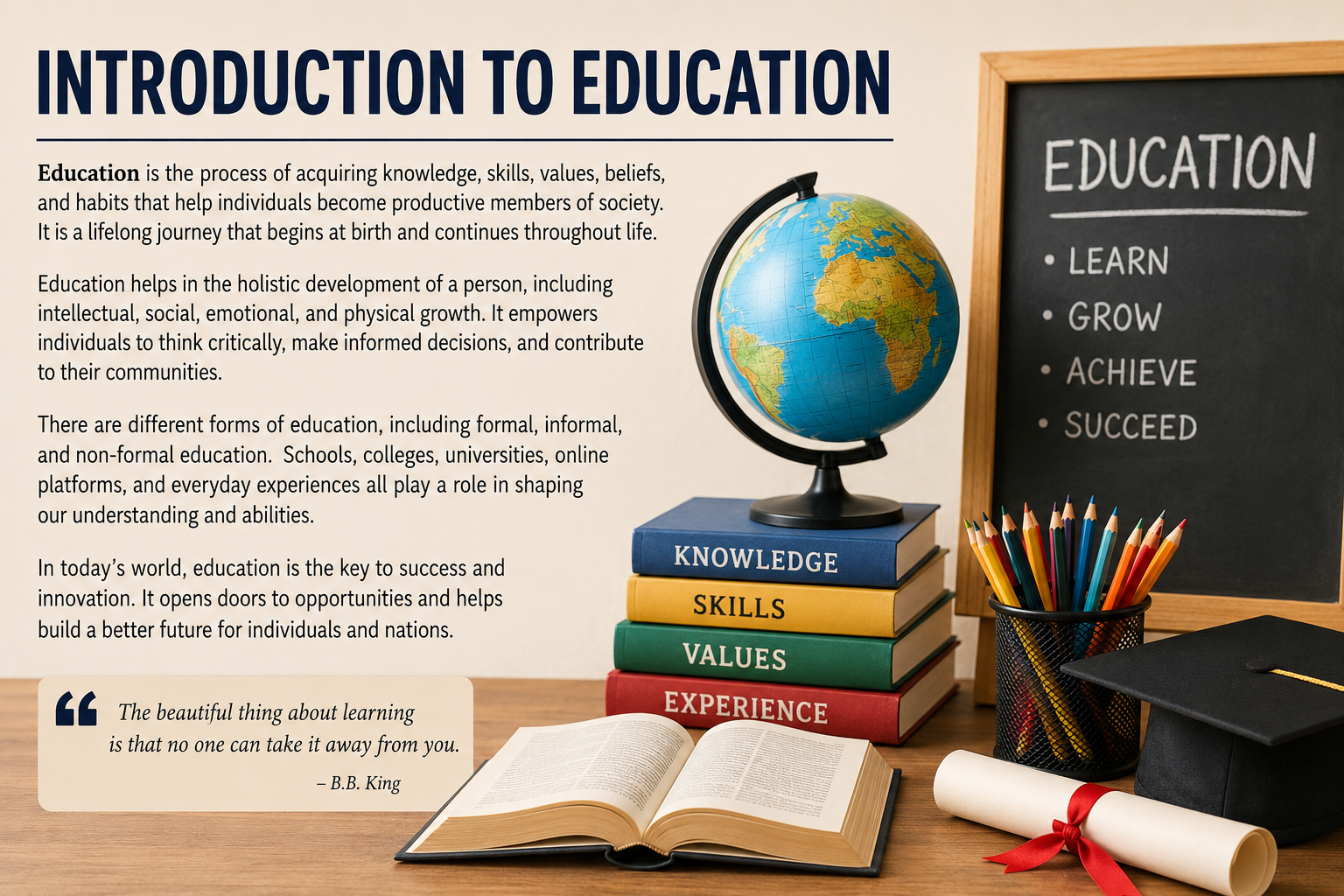
Education is one of the most important foundations of human civilization. It is the process through which people acquire knowledge, skills, values, beliefs, and habits that help them become productive members of society. Education shapes the personality of individuals, improves their understanding of the world, and prepares them to face the challenges of life. From early childhood to old age, learning remains a continuous and lifelong process that influences personal growth and social development.
The concept of education is not limited to schools, colleges, or universities. It includes all experiences that contribute to learning, such as family guidance, social interactions, cultural traditions, books, media, and practical experiences. Education helps individuals develop critical thinking, communication skills, creativity, and moral values. It enables people to make informed decisions, solve problems effectively, and contribute positively to their communities.
Throughout history, education has played a crucial role in the development of societies. Ancient civilizations such as Egypt, Greece, China, and India established systems of learning to preserve knowledge and pass it on to future generations. In those times, education was often limited to specific groups such as priests, scholars, and nobles. Over centuries, the idea of universal education emerged, leading to the establishment of schools and institutions that provide learning opportunities for people from all backgrounds.
Modern education systems are designed to prepare individuals for both personal and professional life. They focus on developing intellectual abilities, practical skills, and social responsibility. Education is often divided into different levels, including primary, secondary, and higher education. Primary education provides basic literacy and numeracy skills, secondary education expands knowledge across various subjects, and higher education offers specialized learning in fields such as science, engineering, medicine, business, and the arts.
One of the key purposes of education is to empower individuals. Educated people are more likely to achieve economic stability, secure better employment opportunities, and improve their quality of life. Education increases confidence and independence by giving individuals the tools needed to pursue their goals and aspirations. It also promotes equality by providing opportunities regardless of gender, social class, or cultural background.
Education is equally important for the progress of nations. A well-educated population contributes to economic growth, innovation, and social stability. Skilled workers enhance productivity, while educated citizens participate more actively in democratic processes and community development. Countries that invest in education often experience lower poverty rates, better healthcare, and higher standards of living. Education also fosters scientific and technological advancement, which drives modernization and global competitiveness.
In today’s rapidly changing world, the importance of education has become even greater. Globalization, technological innovation, and the digital economy have transformed the way people work and communicate. To succeed in this environment, individuals need not only academic knowledge but also critical thinking, adaptability, digital literacy, and problem-solving skills. Education equips learners with these abilities, enabling them to thrive in an increasingly competitive and interconnected world.
Technology has significantly changed the landscape of education. Online learning platforms, virtual classrooms, digital libraries, and educational applications have made knowledge more accessible than ever before. Students can now learn from experts around the world and access educational resources from their homes. However, the integration of technology also highlights the need for responsible use of information and equal access to digital tools.
Education can be categorized into formal, informal, and non-formal learning. Formal education takes place in structured institutions such as schools and universities, where students follow a defined curriculum and receive recognized qualifications. Informal education occurs naturally through daily experiences, family interactions, and self-learning. Non-formal education includes organized learning activities outside traditional institutions, such as vocational training programs, workshops, and community courses. Together, these forms of education contribute to the holistic development of individuals.
Despite its many benefits, education faces several challenges worldwide. Millions of children and adults still lack access to quality education due to poverty, conflict, discrimination, inadequate infrastructure, and social inequalities. In some regions, girls face barriers to education because of cultural norms and economic difficulties. Addressing these challenges requires the collective efforts of governments, educational institutions, communities, and international organizations to ensure that education is accessible, inclusive, and equitable for all.
Education is also closely linked to personal character and moral development. It teaches values such as honesty, respect, discipline, tolerance, and responsibility. Through education, individuals learn to appreciate diversity, understand different perspectives, and build peaceful relationships with others. These values are essential for creating harmonious societies and promoting global understanding.
In conclusion, education is far more than the acquisition of knowledge. It is a transformative force that shapes individuals, strengthens communities, and drives national development. By empowering people with skills, values, and opportunities, education helps create a more prosperous, innovative, and just society. Investing in education is investing in the future, as it remains one of the most powerful tools for improving lives and building a better world for future generations.